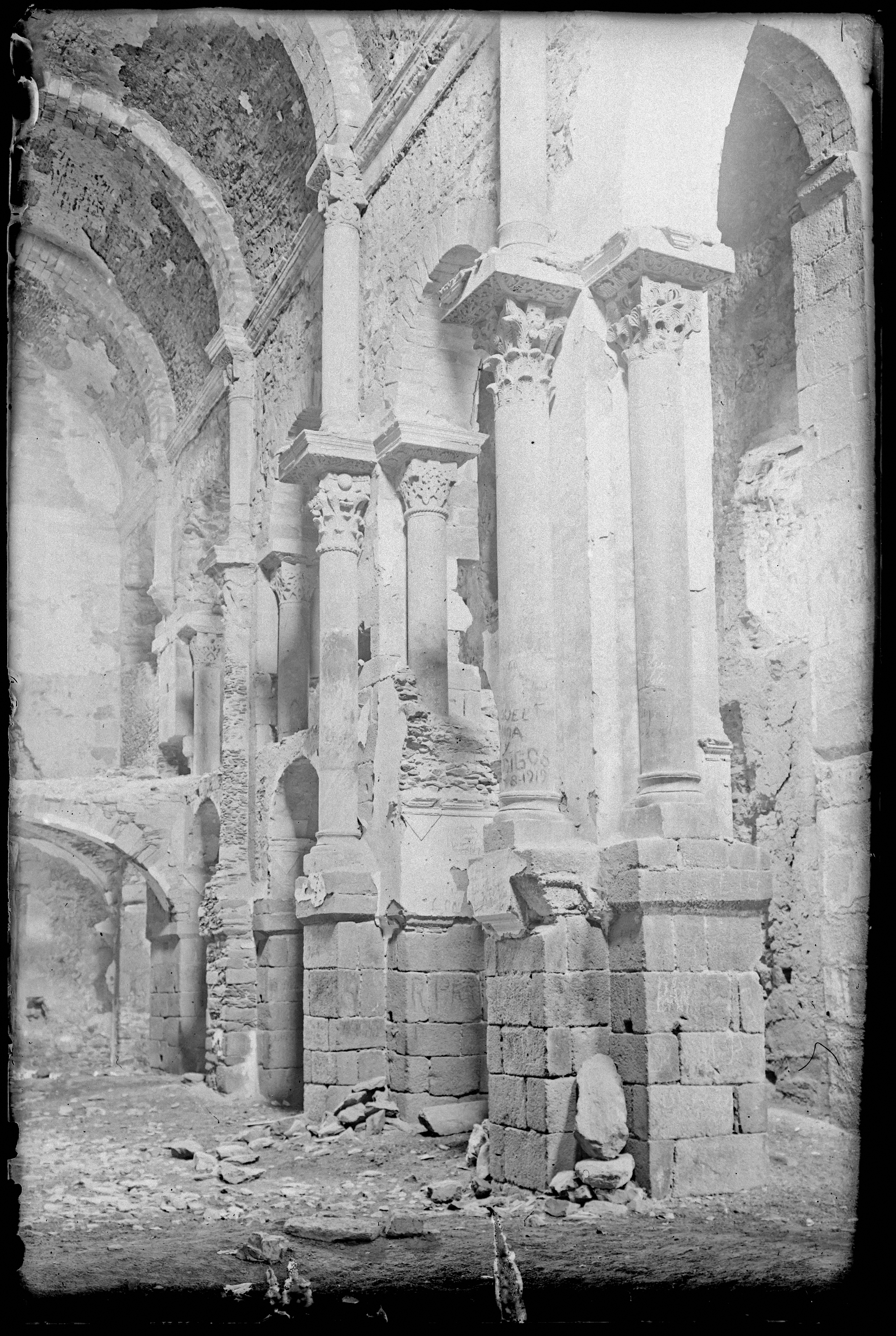
This exhibition is a tribute to the most brilliant and internationally renowned sculptor of Catalan Romanesque art, the Master of Cabestany—considered by some a true 12th-century Picasso—and to his masterpiece, the now-lost western portal of Sant Pere de Rodes, in El Port de la Selva (1160–1170).
Many questions remain about the remarkable life journey of the Master of Cabestany—spanning Tuscany, the Midi, Catalonia, and Navarra—as well as the original sources and intentions behind his art, which the exhibition seeks to explore.
The appearance of a number of works from this ensemble and the acquisition of four of them by the MNAC have made possible this ambitious and far-reaching exhibition, which aims to highlight the originality and “modernity” of this itinerant artist within the European Romanesque context, while drawing attention to the extraordinary artistic significance of the Benedictine abbey of Sant Pere de Rodes and its long and turbulent heritage. In this monastery, where nature is inseparable from art, the site has become a contemporary myth in the history of Romanesque art.
The exhibition will bring together more than one hundred pieces—including sculpture, painting, illuminated manuscripts, drawings, and documents—from national and international museums, libraries, and archives (Cluny, Toulouse, Avignon, Paris, Pisa, Cremona, Rome, Turin, London), with the particularity of including previously unseen works and documents. Visitors will be able to see Romanesque art alongside Roman sarcophagi, reused or brutally fragmented pieces, travelers’ accounts, reports on the monastery’s dismantling, and records of the gradual recovery of the site’s memory—all in one space.
This will allow reflection on a series of fascinating themes related to the construction of the myth of the abbey of Rodes—the mythopoeic power of the landscape, its early connections with Rome, the monastery’s role as a pilgrimage destination—as well as on the surprising “retrospective” art of the Master of Cabestany, who drew inspiration from late Roman sarcophagi. His greatest work, the extraordinary western marble portal of Sant Pere de Rodes, unfortunately destroyed in the first third of the 19th century, will be one of the central focuses of the project.
The exhibition will immerse visitors in a series of narratives that transport them to the past and will be divided into three major sections. The first will address the destruction and dispersal of the portal in the 19th century and the subsequent emergence of contemporary heritage awareness. The second will present the golden age of the medieval monastery through its ties with Rome, the creation of legendary narratives, and the realization of a marble portal, for which a new reconstruction proposal will be offered. Finally, the exhibition will reflect on the Master of Cabestany’s ancient inspiration and the retrospective character of his art and technique, displaying other examples from the 11th–12th centuries from across Europe alongside Roman sarcophagi and reliefs.