

Displaying 55 - 72 of 195
Drawing
This work has been selected for the project 'Partage Plus - Digitising and Enabling Art Nouveau for Europeana'

Drawing
This work has been selected for the project 'Partage Plus - Digitising and Enabling Art Nouveau for Europeana'

Drawing
This work has been selected for the project 'Partage Plus - Digitising and Enabling Art Nouveau for Europeana'
Drawing
This work has been selected for the project 'Partage Plus - Digitising and Enabling Art Nouveau for Europeana'
Drawing
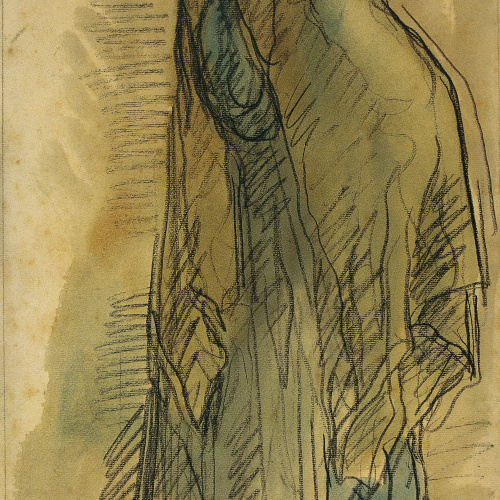
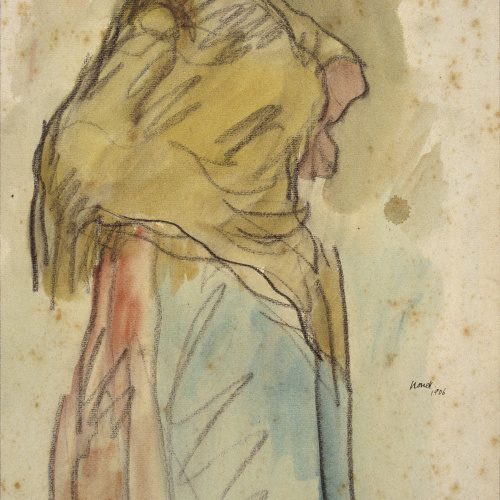
Nonell, one of the most unusual characters in the Catalan art world of the end of the nineteenth century and the beginning of the twentieth, centred his attention on depicting people on the fringes of society, such as cretins, beggars and homecoming soldiers, a subject matter that raised a certain controversy among the bourgeoisie and the well-to-do society of the time. From 1901 he felt a certain predilection for representing Gypsies, which he gave vent to in both painting and drawing until 1908. In this drawing we see a tendency in Nonell to synthesise his figures and turn them into corporeal forms through the use of colour and line, while rejecting anecdotal aspects.This work has been selected for the project 'Partage Plus - Digitising and Enabling Art Nouveau for Europeana'
Drawing
This work has been selected for the project 'Partage Plus - Digitising and Enabling Art Nouveau for Europeana'
Drawing
This work has been selected for the project 'Partage Plus - Digitising and Enabling Art Nouveau for Europeana'

Drawing
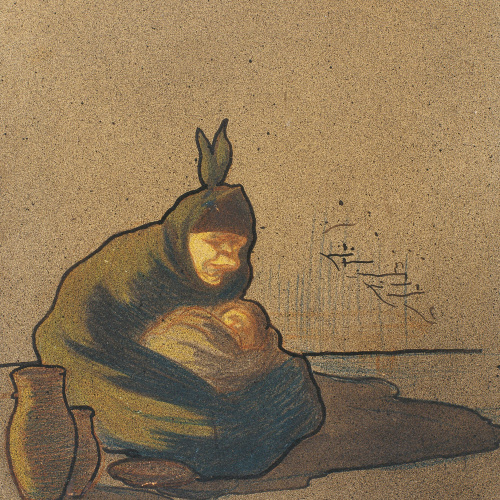
Nonell spent the summer of 1896 in a spa of Caldes de Boí. In Boí the artist closed a period dedicated to landscape and opened another in which the human figure was now the protagonist, inclining especially towards those more socially grotesque and marginal beings: cretins, gypsies, old men, ragmen, etc. Despite the fact that he did paint some landscapes like the ones he had done in Barcelona, the most notable work he did in that time were the drawings featuring cretins in which for the first time the singular and strong personality of Nonell was manifested. Taking into account the fact that this drawing is in ink and with coloured pencils, we could guess that Nonell did it on returning to Barcelona, based on the sketches he had done in Boí, in pencil. In this definitive version of a cretin with his son in a snow-covered landscape, framed by the Romanesque church of Sant Pere d'Escunyau, in the vall d'Aran, it is very especially evident the influence of the Japanese prints.This work has been selected for the project 'Partage Plus - Digitising and Enabling Art Nouveau for Europeana'

Drawing
This work has been selected for the project 'Partage Plus - Digitising and Enabling Art Nouveau for Europeana'


![image for: Isidre Nonell - Home assegut (anvers) / Home assegut (revers) - Cap a 1890-1900 [1]](https://www.museunacional.cat/sites/default/files/styles/resize_500x500/public/images/art_piece/first_gallery/54864/026894-D0R.JPG "Isidre Nonell - Home assegut (anvers) / Home assegut (revers) - Cap a 1890-1900 [1]")
Drawing
This work has been selected for the project 'Partage Plus - Digitising and Enabling Art Nouveau for Europeana'
Drawing
This work has been selected for the project 'Partage Plus - Digitising and Enabling Art Nouveau for Europeana'
Drawing
This work has been selected for the project 'Partage Plus - Digitising and Enabling Art Nouveau for Europeana'

Drawing
This work has been selected for the project 'Partage Plus - Digitising and Enabling Art Nouveau for Europeana'

Drawing
This work has been selected for the project 'Partage Plus - Digitising and Enabling Art Nouveau for Europeana'

Drawing
This work has been selected for the project 'Partage Plus - Digitising and Enabling Art Nouveau for Europeana'

Drawing
This work has been selected for the project 'Partage Plus - Digitising and Enabling Art Nouveau for Europeana'

Drawing
This work has been selected for the project 'Partage Plus - Digitising and Enabling Art Nouveau for Europeana'